
2025 Gala Recap: Honoring Joshua Levy & Welcoming Rana Kannan



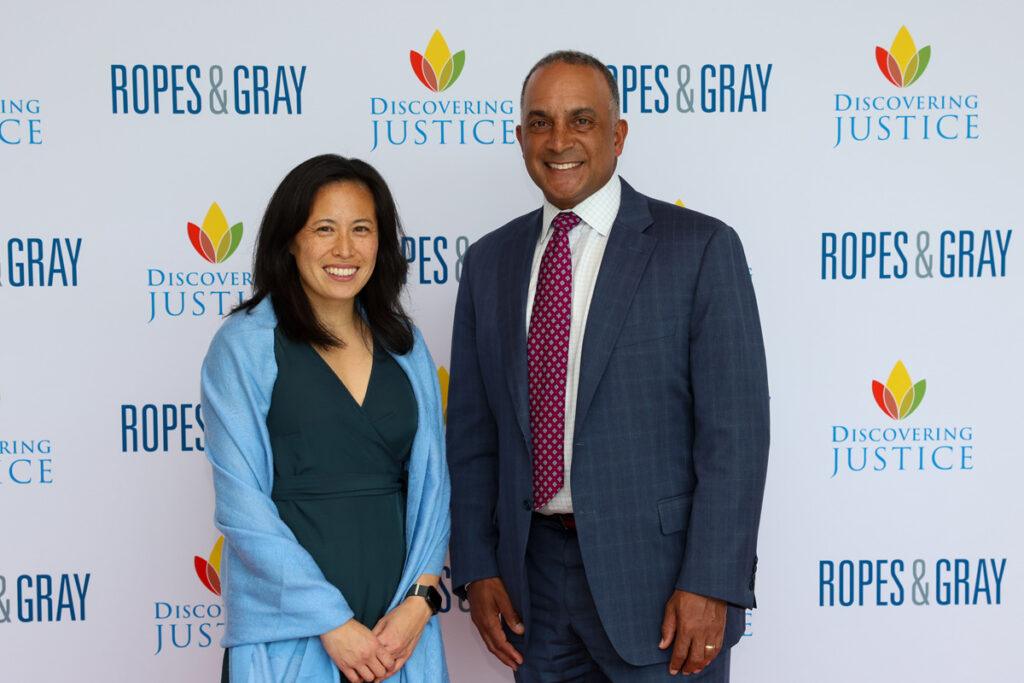






Discovering Justice is grateful to the community of corporate sponsors, foundations, individual donors, and school districts who make our work possible—and who came together to celebrate civic education and youth empowerment at our 2025 Annual Gala.
We were honored to welcome Ropes & Gray as our Presenting Sponsor, whose leadership and support helped make the evening a tremendous success.
This year’s Gala marked a new chapter for Discovering Justice as we introduced Rana Kannan, our incoming Executive Director. Rana brings a bold vision and deep experience in the education space that will help propel us into our next chapter.
We were also proud to honor Joshua S. Levy, former United States Attorney for the District of Massachusetts, with our Champion of Justice Award. Josh’s decades-long service as a mentor to students and Trustee has shaped the heart of this organization and inspired the next generation of changemakers.
The strength of this event would not have been possible without the tireless work of our 2025 Gala Committee:Lo Stark, Lenore Lobel, Louis Lobel, Michael Anderson, Sarah Walters (Gala Chair), Jennifer Brown, and Becca Solomont. Their creativity, dedication, and leadership helped bring our mission to life in powerful ways.
We also extend a heartfelt thank you to Goodwin Procter LLP and WilmerHale, our 2025 Guardian of Justice, whose continued volunteerism and philanthropic partnership have helped bring justice education into classrooms and courtrooms across the Commonwealth.
Together, we continue to show what’s possible when a community invests in democracy and the potential of its youngest citizens.
Thank you to everyone who made Gala 2025 unforgettable.
Discovering Justice’s 2025 Gala gathered more than 250 supporters in the Moakley Courthouse to celebrate Joshua Levy, former United States Attorney for the District of Massachusetts (and former DJ board member!)
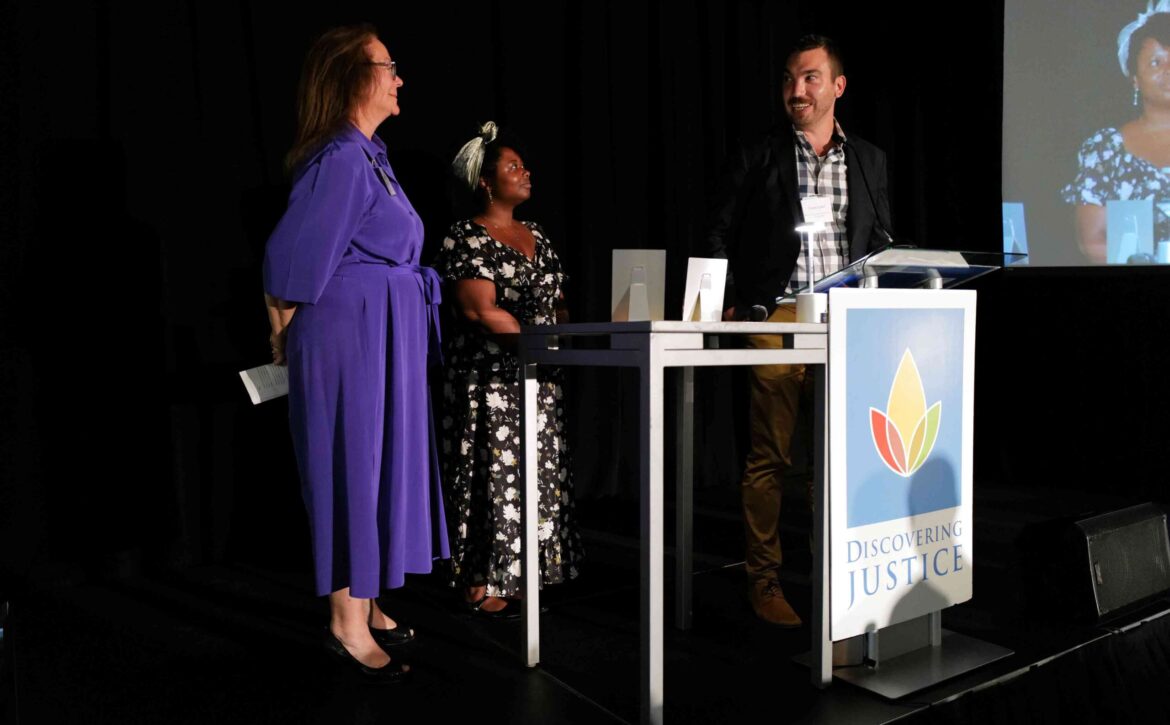
Our Board Chair, Tony Jordan opened the event and introduced new Executive Director, Rana Kannan! We then heard from Gala Committee Chair Sarah Walters. Following a delicious dinner and exciting live auction, Josh Levy was joined onstage by three Discovering Justice students and national-award-winning journalist Phillip W.d. Martin of WGBH. Martin facilitated a riveting conversation.
We raised nearly $500,000 to support quality civic education for students and communities across the Commonwealth, an incredible success only made possible by the remarkable generosity of our sponsors.
We’d like to give special thanks to presenting sponsor Ropes & Gray, as well as forty-two other firms, foundations, and individuals whose generosity will fuel Discovering Justice’s mission for another year.

Discovering Justice is fortunate to have corporate, philanthropic foundations, individual donors, and school district supporters who all come together with the resources we need to do our work.
Goodwin Procter is one such partner. Goodwin’s generous and consistent financial support of Discovering Justice’s work has provided us with the capacity to grow from an idea to one of the foremost civic education groups in the Commonwealth.
For the passion, perspective, and energy Goodwin brings to our partnership, Discovering Justice was proud to present Goodwin Procter with our 2024 Partner for Justice Award at our Annual Gala 2024: Partners for Justice on June 26th.
For more than over 20 years, Goodwin’s attorneys and staff have volunteered their time and expertise to our programs, most notably as Legal Mentors in our Mock Trial and Mock Appeal teams in Boston. This spring, Goodwin attorneys mentored middle school teams from St. John’s Parochial School in Boston and North Middle School in Brockton.
And Goodwin’s leadership has been vital to Discovering Justice’s direction and growth. We’re proud to name Goodwin’s Deborah Birnbach as former Chair of Discovering Justice’s Board of Trustees, and Marieljane Bastien and Louis Lobel as current Board Members.

Accepting Goodwin’s award last week, Birnbach and Lobel commended the work of Discovering Justice as essential to building future leaders, noting that our programs help prepare the young people not only of Boston but across the Commonwealth to explore the justice system firsthand and start to become active, engaged participants in our democracy and affirming that “Goodwin is proud to support that work.”

Our partnership with Goodwin proves that when we come together and all bring what we can to the table, we can all reach further, aim higher, and help build a stronger future for our students. Thank you, Goodwin Procter!



When Massachusetts state legislators were on the path to cutting the Commonwealth’s investment in civics education, Senator Becca Rausch arrived at the floor of the State Senate chambers to not only stop the cuts, but also to increase support by 25%.
The vote passed 39-0, with both Democrats and Republicans unanimously lining up behind her amendment.
Through her passion for civic engagement and her persistence, Senator Rausch has emerged as a leader on Beacon Hill to bring robust civic education to every student in Massachusetts.
For her tireless and dedicated work at the State House, we are proud to honor Senator Rausch with our Discovering Justice 2024 Partner for Justice Award.
We hope you’ll join us at Discovering Justice’s Annual Gala 2024: Partners for Justice on June 26th as we celebrate Senator Rausch and the partners that make our impactful work possible.
Discovering Justice is proud to be a part of the Massachusetts Civic Learning Coalition (MCLC), a coalition of more than 50 civic education groups in Massachusetts who work with school districts and teachers to help bring civics into the classroom. MCLC was formed in 2017 and led the campaign to pass the groundbreaking Civics Education Law that prioritized civic education for Massachusetts students.
Since the passage of the law, Discovering Justice and MCLC have worked with Senator Rausch and many other Massachusetts legislators to increase the Commonwealth’s investment in civic education by 67%.
During the Senate debate last month, Senator Rausch spoke passionately from the Senate floor:
“Civic education is both profoundly important and a necessary equalizer. It empowers young people from all backgrounds and all communities to make their voices heard as they advocate for the issues and values that matter most to them. Civics teaches the power of the grassroots and delivers the experience of influencing law and policy even before our students are old enough to vote, so when the time comes for them to start casting their ballots, they know how much it matters to exercise that right and engage in our democracy.”
Senator Rausch also appreciates the role Discovering Justice plays in the education of Massachusetts citizens:
“From Mock Trials, to Courthouse Tours, to [Civic Learning] Weeks, Discovering Justice brings students of all ages into the rooms where policy is made, democracy lives, and equity advances. It is truly transformational for a student to enter these spaces; the experience inspires students in the moment and empowers them to envision themselves there in the future. Discovering Justice demystifies the world of government, opening it up to one and all.”
Thanks and congratulations to Senator Becca Rausch for her work and dedication to civic education.
First elected in an iconic 2018 victory, Massachusetts State Senator Becca Rausch (D-Needham) represents the Norfolk, Worcester and Middlesex District. She is the first woman and first Jewish person to serve several of the district’s communities in the Senate. Re-elected in 2020 and 2022, Senator Rausch is currently serving her third term and is the only mother of children under 10 years old in the Massachusetts Senate. The granddaughter of a Holocaust survivor and a published author on reproductive health and justice and body size and the law, Senator Rausch is a lifelong advocate for social justice, fairness, and equity for all.
Discovering Justice is grateful for Senator Rausch’s partnership as our champion for civics education in the Massachusetts legislature. We’re looking forward to presenting Senator Rausch’s award, as well as hearing from all our 2024 Partner for Awardees on the importance of doing work they believe in, at our Annual Gala on June 26th.
|
|
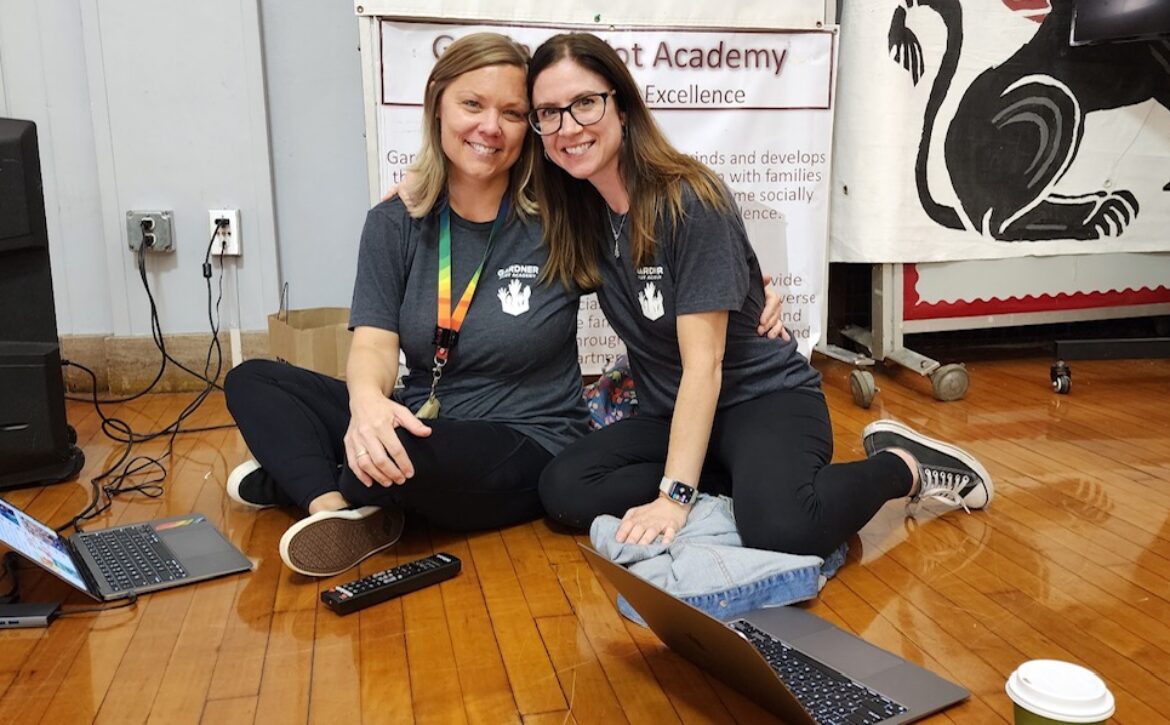
You can celebrate Tracy and Christy, and all of our 2024 Partners for Justice Awardees, at Discovering Justice’s Annual Gala 2024: Partners for Justice on June 26th.
Christy and Tracy recognize that CDJ meets an underserved need for civics programming in early-childhood classrooms like theirs, with lessons designed to help the Commonwealth’s youngest learners engage with the concepts of justice and fairness and explore school and community issues.
And their kindergartners are hungry for it! According to Gardner Pilot Academy colleague Gaby Haywood, “Through CDJ, Christy and Tracy provide their students with a strong foundation of the understanding of what is justice and injustice in the world, and their students learn to use the language from the lessons in everyday conversations.”
Gaby adds, “These rich conversations are thanks to the hard work and dedication from Christy and Tracy!”
Tracy and Christy’s partnership with each other and with Discovering Justice means that our CDJ curriculum helps a growing number of young students jumpstart their justice journey as they begin to explore and engage with civic education and action. As Tracy puts it, “Partnership makes us successful.”
Discovering Justice is grateful for Tracy and Christy’s partnership over the years. We’re looking forward to hearing from Tracy and Christy on the importance of making civic education accessible to our youngest learners at our Annual Gala on June 26th.
For over two decades, Discovering Justice has been bringing students and communities together to examine the workings of the justice system, explore the ideals of justice, and prepare them to engage as active citizens. We believe in the power of the next generation to sustain our democracy. We value the belief that the justice system can and should work for everyone.
Discovering Justice’s Director of Programs and Partnership will play a critical leadership role in working with staff to ensure development and implementation of high quality, culturally responsive, timely and innovative civic education programs for K-12 students and community members across Massachusetts. These programs include our courthouse programs (K-12 field trips, college+adult tours, and events), in-school K-5 curriculum, teacher professional development, and after-school mock trial and appeal program for middle school students.
The organization serves more than 30,000 students across 40 cities/towns in Massachusetts. Each year through our programs we bring 3,000 students and adults into the Moakley courthouse, maintain a network of over 300 legal professional volunteers, engage 600 middle schoolers in our afterschool program, provide professional development to 300 teachers, and create curriculum for 20,000 students. You’ll not just be directing this work; you’ll be ensuring the programs are in alignment with our core values, centered around students and community needs, and prioritizing that every step we take resonates with our mission and commitment to diversity, equity, and inclusion.
As the Director of Programs and Partnerships, you’ll be the driving force behind building the capacity of our programs and staff by leveraging research and best practices to ensure our work and impact is responsive to current needs and aligned with the programmatic vision, building and maintaining our volunteer network, and supporting program implementation on the ground level. The Director of Programs and Partnerships will help develop and operationalize the strategic vision and goals across programs as well as supervise, collaborate with, and support the program staff. As Discovering Justice is a small team, you will have the opportunity to work directly with our programs – leading field trips and tours, recruiting judges, and hosting volunteer events. As a strong relationship builder, you will lead the identification, cultivation, and stewardship of Discovering Justice’s program partners including schools, district leaders, teachers, judges, and lawyers (legal volunteers), and non profit partners.
Program Strategic Planning and Development
Staff Supervision & Development
Direct Program Support
Identifying & Stewarding Partnerships
Organizational Leadership
Your morning might start off by meeting with a group of attorneys who are interested in participating in our Mock Trial/Appeal Program and earning a commitment from them to volunteer next semester as legal mentors. Later you might support the Courthouse Programs Manager in welcoming a group of middle schoolers into the Moakley Courthouse by leading students on a tour and meeting with a federal judge. In the afternoon you will lead a Program Team Meeting on the core pillars of culturally responsive education / programming as you prepare the team to engage in a review of program logic models and SMART goals. You end the day working with a program manager to revise an evaluation tool to better collect program impact data to analyze the impact of our programs.
Discovering Justice values a diverse workforce and is committed to creating a diverse and inclusive environment where we strive to embed equity and inclusion into everything we do.
Our office is situated within the iconic John Joseph Moakley U.S. Courthouse in Boston’s Seaport District. The location allows us to work closely with federal judges and other members of the Courthouse community to make the Courthouse a vibrant civic space. We embrace a hybrid work approach, combining the advantages of face-to-face interactions with the flexibility of remote work.
For this role, in-state travel to meet with foundation staff and corporate sponsors is required. You will typically work at the Moakley Courthouse two days a week and travel on average one day a week for program visits and partner stewarding. You will also help out the Mock Trial and Mock Appeal teams during their culminating events at the end of December and in May. You must have a valid driver’s license, and having a vehicle is preferred, but not necessary.

Alex has over fifteen years of administrative experience, most recently at Boston Schools Fund. Prior to her time at BSF, she served as an Executive Assistant to the Head of School at Mother Caroline Academy, where she also provided major support to the Development office. Before her time at MCA, Alex served as an assistant at a media firm in Washington, DC.
This role oversees financial operations such as reconciliations, expense tracking, payroll, and donor acknowledgments, while managing organizational systems, employee records, and meeting coordination. It also provides event logistics, Board support, and office management, ensuring efficient processes, accurate recordkeeping, and the successful execution of programs, operations, and special events like the annual Spring Gala.

Rana Suh Kannan has spent nearly her entire 20+ year career dedicated to providing students with access to high-quality education experiences that lead to strong academic outcomes. She brings extensive and diverse experiences as a teacher, school administrator, funder, and nonprofit professional. Rana is committed to Discovering Justice’s mission to enable students to become well-equipped with the knowledge, skills, and desire to build and sustain an equitable democracy.
Prior to Discovering Justice, Rana spent seven years at Boston Schools Fund, most recently as the Chief Operating Officer. She co-led the development of the organization’s second fund, and ensured its operationalization across the organization. Previously, Rana played pivotal roles at organizations such as Salsify, Phoenix Charter Academy, The Achievement Network, and Roxbury Prep Charter School. Rana graduated from Williams College with a Bachelor of Arts degree in History and Psychology. She earned her Master’s in Education Policy & Management from the Harvard Graduate School of Education.

Mehana Koch is a recent graduate of Wellesley College, where she earned a BA in Psychology. She joined Discovering Justice excited to learn about nonprofit operations and support an organization whose mission uplifts and empowers future engaged citizens.
At Discovering Justice, Mehana enjoys supporting both the administrative and fundraising needs of the organization. Her day-to-day work includes processing donations, reconciling accounting information, and maintaining a strong database. She also has played a large role in onboarding new staff and supporting large organization-wide events, such as the Annual Gala.

Bianca Lora is passionate about expanding access to civic education, uplifting historically underrepresented voices, and creating spaces where young people can grow as informed and active members of their communities. With a background spanning across organizing, policy, and fundraising, she brings a collaborative spirit to the work.
Prior to this role, she led cross-departmental initiatives for donors at the ACLU of Massachusetts, including its 800-person annual gala. Bianca has also served as a Senior Legislative Assistant for a Councilmember At-Large in Montgomery County, Maryland where she oversaw a legislative portfolio on government operations, economic development, public safety and social justice issues. She also launched an organizing campaign alongside the adjunct faculty at Prince George’s Community College with SEIU.